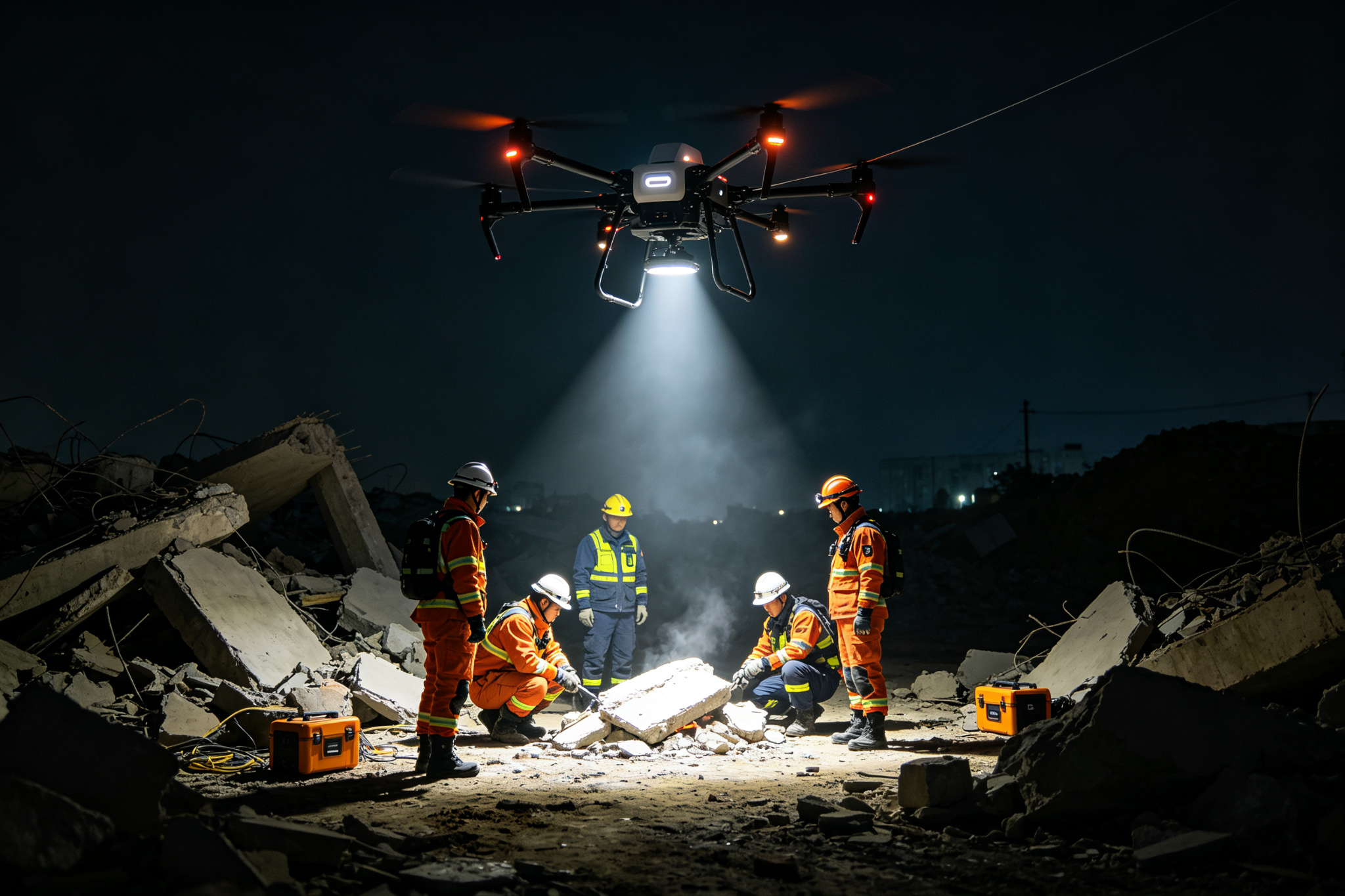
Upgraded Night Rescue Capabilities: Lighting Drones as Core Equipment of Modern Emergency Support Systems
As the demand for emergency response to natural disasters such as earthquakes, floods and landslides continues to rise, night operation capability has become a key indicator for evaluating the combat effectiveness of emergency rescue systems. Traditional ground lighting equipment, including lighting vehicles and mobile light towers, suffers from slow deployment, poor terrain adaptability and limited coverage. In contrast, tethered lighting drones feature rapid deployment, high-altitude hovering and wide-area illumination, gradually becoming standard equipment for professional emergency rescue teams.
Industry statistics show that China’s market for emergency tethered lighting drones will achieve an annual growth rate of over 42% from 2024 to 2026, with fire rescue, power maintenance and security emergency scenarios accounting for 71% of total market demand. The industry is undergoing an in-depth transformation from single equipment procurement to systematic solution adoption. End users now prioritize endurance stability, environmental adaptability and multi-payload integration capabilities, rather than focusing merely on lighting brightness.
In practical applications, lighting drones deliver outstanding value in three major scenarios:
First, disaster rescue and emergency responseTraditional lighting devices are often difficult to deploy rapidly at disaster sites such as earthquake ruins, flood dam repair zones and landslide areas. Lighting drones can be airborne within 3 minutes and hover at altitudes of 50 to 100 meters, covering an operational area of several thousand square meters. Combined with infrared thermal imaging devices, they enable precise positioning of trapped personnel, securing critical time for night rescue operations.
Second, power and engineering maintenanceFor night power grid troubleshooting, railway line maintenance and bridge emergency repairs, lighting drones flexibly adjust illumination angles and hovering heights to replace conventional ground light towers, greatly improving the efficiency of night operations in complex field terrain.
Third, large-scale events and public security guaranteeLighting drones provide unobstructed high-altitude full-domain illumination for security surveillance at night sports events, music festivals and large gatherings, as well as on-site command lighting during sudden public emergencies, supporting efficient on-site scheduling and disposal.
Notably, operational reliability in extreme environments has become a core assessment standard for lighting drones. Complex working conditions including extreme cold in northern winters, low temperatures in high-altitude mountainous areas, and high humidity and salt fog in coastal regions impose stringent requirements on drone power systems and battery performance. Special battery solutions with wide-temperature adaptability, anti-vibration impact resistance and stable long-duration discharge have become essential for product upgrading of lighting drones.
Furthermore, with the systematic development of emergency equipment, multi-functional drone systems integrating lighting, communication relay, video transmission and loudspeaker command will dominate the future development trend of emergency rescue equipment.